Australasian Network for Asian Art

2026 AN4AA Postgraduate Symposium | Asian Art Research Now
The Afterlives of Asian Art
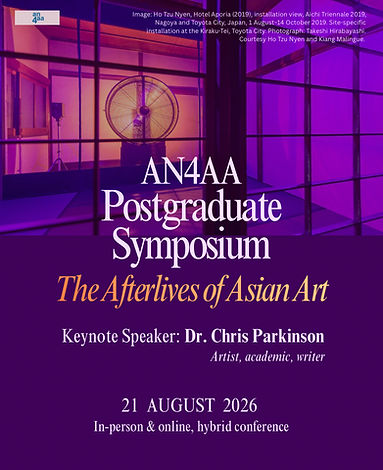
Friday 21 August 2026
9.00 - 16.00 AEST
11.00 - 18.00 NZST
Register via Humanitix
A Zoom link will be provided once registered. If you are attending in person, please select one of the locations below when registering with us.
Adelaide: Collab, Police Barracks Building Level 1, South Australian Museum, North Terrace, Adelaide, SA 5000
Melbourne: Asia Society, Level 2, Building 8, RMIT University, 368 - 374 Swanston St, Melbourne, VIC 3000
Sydney: Room A101, A Block, UNSW Art & Design, Oxford St & Greens Rd, Paddington, NSW 2021
Wellington: Room WIG 202, Te Herenga Waka - Victoria University of Wellington, 139 Vivian St, Te Aro, Wellington
Click to download booklet.
2026 marks the ninth year since the establishment of Asian Art Research Now, the annual postgraduate symposium organised by the Australasian Network for Asian Art (AN4AA).
The 2026 symposium thematically explores the afterlives of Asian art—when artworks, objects, and creative practices persist, circulate, and acquire new meanings beyond their original contexts. By examining these afterlives, we can better understand not only what survives, but how and why it endures. This perspective highlights the influence of archives, museums, historians, and contemporary practitioners in shaping present-day understandings of Asian art. Yet, while these institutions can generate new meanings, they risk reductionist interpretations, particularly in the context of post-colonial legacies that reflect or reinforce power dynamics, privileging certain narratives while marginalising others. Thus, this symposium also invites critical inquiry into the roles and practices of these institutions.
The symposium will take place in a hybrid format, with in-person hubs in Australia and Aotearoa New Zealand hosted at the Art Gallery of South Australia (Adelaide), RMIT (Melbourne), University of New South Wales (Sydney), and the University of Wellington in Aotearoa New Zealand. The day-long symposium aims to highlight and share the vitality and diversity of Asian art research undertaken by current and recent postgraduate students. It aims to foster supportive critique, feedback, and conversations across institutions and across the diverse geographies and temporalities of Asian art research.
The symposium serves as a platform for connecting with other scholars and emerging academics across Australia and Aotearoa New Zealand. It provides an opportunity to share research in progress among Asian art researchers from various backgrounds, including Master's (coursework or research) students and doctoral candidates in disciplines such as art history, creative practice, arts management, museum studies, and heritage studies.
2025 marks the eighth year since the establishment of Asian Art Research Now, the annual postgraduate symposium organised by the Australasian Network for Asian Art (AN4AA). Over the years, this symposium has become a flagship event for the network, bringing together early-career Asian art researchers from Australia and Aotearoa New Zealand (and beyond) to share their research-in-progress with their peers and experts in the field.
This year, we welcome multi-disciplined artist, Chris Parkinson, to present the keynote speech.
Keynote
.jpg)
Chris Parkinson is a multi-disciplined artist engaging practice, research and programming across academia, the public sector, independent consulting and publishing. His research focuses on the production of public, urban space through collaborative and collective art practices, urban surface studies, informal economies and the governance of criminalised practices.
Parkinson’s collaborative practices have been shaped through art collectivism and sustain a strong connection to the Southeast Asian region. His 2010 book, Peace of Wall: Street Art from East Timor, is described as a ‘book of evocative photojournalism capturing an important moment in East Timor’s history through its walls.’
His PhD (2025) studied the Indonesian Art Collective SURVIVE! Garage through practice-led research, linking a global history of art collectives to Indonesian creative practices through the sociological framework of Henri Lefebvre. It found new modes of engaging rhythm as
theoretical analysis and creative methodology in a cross-cultural artistic context. Working primarily through lens-based processes and practices, Parkinson retains his roots to graffiti through subverting contemporary letters through concepts indebted to seriality and abstraction, rhythm and affect, text and subtext.
Image: Chris Parkinson. Photograph: Juan Castro.
Keynote Abstract
Du Du Da Da: Fragments of an Afterlife of Practicing Practices
Peering through the surface of “The Window” and sitting at “The Wall”, Parkinson presents a reproduction of urban surfaces as sites of dialectic potential.
Through engaging surfaces, Parkinson will present a developing understanding of a self-designated practice - refractive practice - where the indexical, the interpretive and the abstract mingle in the margins of cross-cultural collaboration revealing the affective power of the relational through the materiality of surfaces.
The late photographer Ray K. Metzker insisted upon an ‘interruption to pictorial veracity’ in his practice. Says Metzker: “A lot of my work is about events, but a lot is about fragmentation. You have to break something down in order to have the parts synthesise.”
Beginning with a fragmented reproduction of an ethnographic image exhibited as part of research into the Indonesian Art Collective, Survive! Garage, Parkinson’s presentation brings urban rhythm, space, time, fact, fiction and ethnographic performativity to bear upon a practice informed through Henri Lefebvre’s concept of “spectral analysis” in which “something apparently simple is refracted through a prism to reveal, however incompletely, its elements and history.”
Image: Chris Parkinson, THE MONUMENTAL RUPTURE OF THE UN.DE.BAT.A.BLE CYCLE OF THE MO(U)RNING AND THE NIGHT, 2024. Photograph: Dan Sibley.

Program Schedule
